
The Probability Outlook
Chips Try to Bounce. Strong Jobs Raise the Stakes.
Archived issue, 11-06-2026. Odds and methods are as of that date; see the Method page for the current Four-Gate rules.
Today’s Market-Moving News
- AI shares face a recovery test: The Nasdaq Composite fell 5.52% Thursday as investors reassessed data-center expansion risks after the midterms, leaving Friday’s early technology rebound to prove it can last. Source: Fox Business
- Hiring strengthens: October payrolls rose 165,000 and unemployment changed little at 4.1%, complicating the interest-rate outlook as investors weigh resilient growth against inflation pressure. Source: BLS
- Oil’s weekly slide meets shipping risks: Crude remained headed for a steep weekly decline on hopes of Iran-war de-escalation, while continuing vessel attacks threatened supply. Source: Reuters
- Britain tightens policy: The Bank of England raised Bank Rate to 4% and projected inflation near 5% by mid-2027, underscoring the continuing strain from energy costs. Source: Bank of England
The Lead Story: The AI Buildout Faces a Political Test
The AI trade enters Friday trying to recover from a selloff that sent the Nasdaq Composite down 5.52% and the S&P 500 down 4.4% on Thursday. Investors are reassessing how opposition to data-center construction following the midterm elections could affect the pace and cost of AI expansion.
Chipmakers bore the brunt: the Philadelphia Semiconductor Index fell about 12%, with Nvidia, AMD and Micron among the major casualties. AP linked the selling to concerns that Democratic election gains could lead governments to pause data-center construction, alongside existing worries about borrowing costs. Those are prospective risks to the buildout; the report does not establish a quantified reduction in future chip orders. Source: Fox Business, AP
OpenAI’s response shows why local approval matters. Its National Community Compact, published November 5, commits future campuses it owns and operates to cover their electricity and supporting infrastructure costs, publish resource-use information, and engage residents while plans can still change. Those commitments address real development obstacles, but they do not establish that proposed projects will receive approval or remain on schedule. Source: OpenAI
Friday’s first indications offered some relief: Nasdaq futures were up about 1.4% after the jobs release, while S&P 500 futures gained about 0.3%, according to Reuters’ morning snapshot. These were premarket indications, not completed-session gains; stronger hiring also pushed Treasury yields higher, adding a financing-cost challenge to the attempted recovery. Source: Reuters
The unresolved issue is how much political opposition becomes binding restrictions, and how much construction can move to other locations. Campaign promises alone do not establish nationwide policy or quantify lost revenue. Project approvals, customer spending plans and company guidance will offer firmer evidence of whether this is a delay in the buildout or a lasting reduction in demand.
Also Moving Markets
Strong hiring complicates the rate outlook
October’s 165,000 payroll gain came with a combined 84,000 upward revision to August and September, while average hourly earnings rose 0.4% for the month and 3.1% over the year. Professional and business services led hiring with 70,000 additional jobs. The figures support the case for resilient demand, but also give the Fed less evidence of labor-market weakness when weighing inflation risks; Reuters reported at 8:48 a.m. ET that market bets on a December rate increase rose to 78% after the release from 70% beforehand, though that pricing does not determine the Fed’s decision. Source: BLS, Reuters
Oil prices reflect hopes that shipping conditions have yet to deliver
Reuters reported Friday that crude was headed for a sharp weekly decline as the election outcome raised hopes of de-escalation in the Iran war. Continuing attacks on vessels kept supply concerns alive, however, leaving a gap between expectations for diplomacy and conditions on shipping routes. A sustained fall in energy costs could relieve pressure on consumers and transport companies, but that benefit remains exposed to renewed disruption. Source: Reuters
The Bank of England acts on energy-driven inflation
The Bank of England raised Bank Rate by a quarter percentage point to 4% in its November 5 announcement, with an 8–1 vote; the dissenting member preferred a larger increase. The bank expects inflation to reach around 5% by the middle of next year. It sees limited evidence so far of knock-on effects on other prices and wages, but judges the risk of persistent inflation to have risen as the energy shock continues. Its decision highlights the global inflation constraint facing markets even as oil headed for a weekly decline. Source: Bank of England
What Investors Are Talking About
- The bullish case: Some sampled X discussions frame the AI selloff as excessive repricing, amplified by positioning and forced selling, while arguing that demand for computing capacity remains intact. Discussions of AI-cloud providers also point to customer prepayments and scarce capacity as possible supports; those are bullish arguments, not independently established conditions across the industry. Friday’s early technology rebound offers an initial test of that view, without establishing a durable recovery.
- The bearish case: Other sampled discussions focus on permitting delays, power and water constraints, high valuations, and the risk that heavy AI investment takes longer to earn a return. Thursday’s sharp semiconductor decline provides concrete evidence of market stress, while claims that the election has permanently impaired the AI cycle remain interpretations requiring project-level and earnings evidence.
These themes reflect a selective X sample from Thursday’s close through 8:42 a.m. ET Friday, not a representative survey of all investors.
The Probabilities
After every close, our models update the odds of a higher closing price at the end of the five-trading-day forecast window than at that close. These were calculated at Thursday’s close, after the selloff but before the jobs report and Friday’s premarket rebound, and do not incorporate the overnight news. In the chart, the bars are Thursday’s odds and the dots are Wednesday’s.
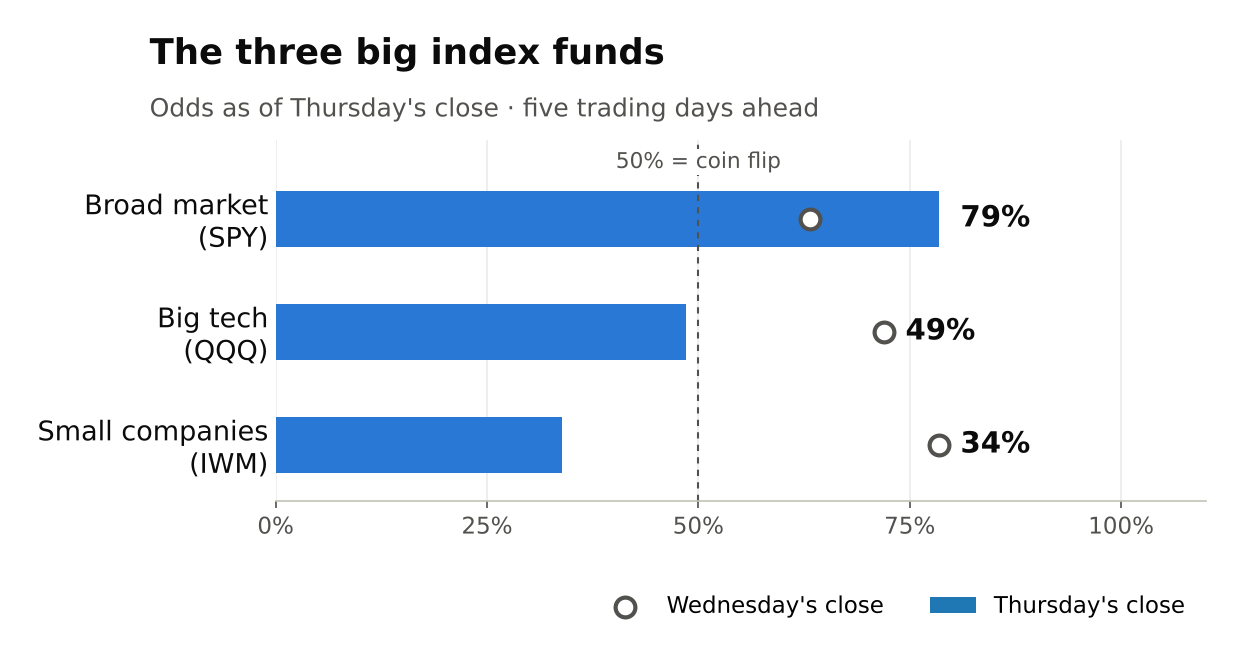
The three funds moved in different directions. The broad market (SPY) rose from 63% to 79%. Big tech (QQQ) fell from 72% to 49%, about a coin flip, and small companies (IWM) dropped from 79% to 34%. Each fund has its own model, built from its own price history, so they don’t have to agree.
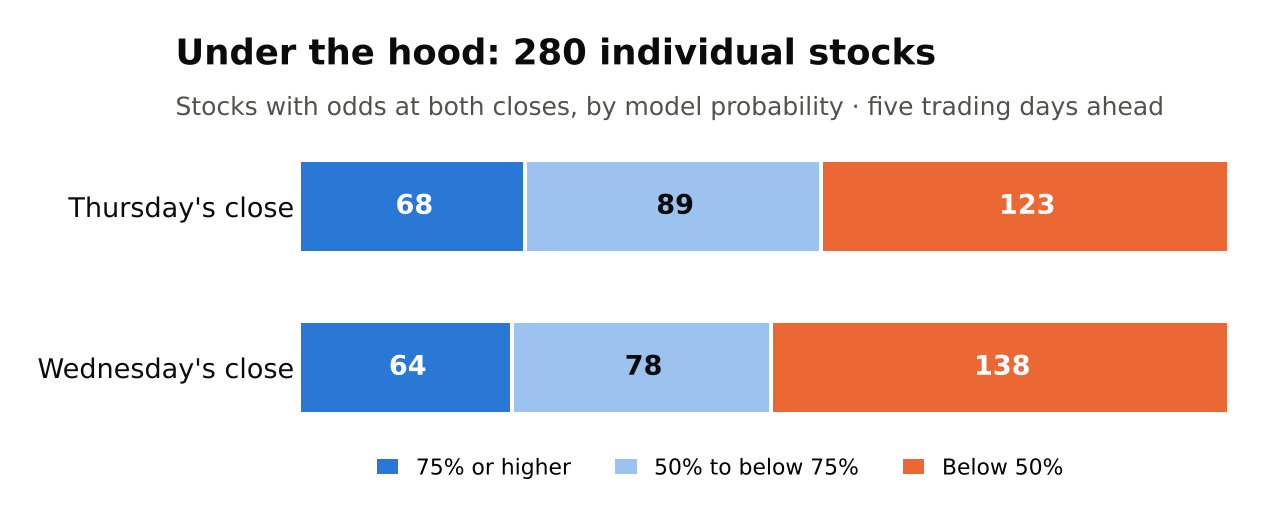
The stock count uses the 280 individual stocks we track that have odds from both Wednesday’s and Thursday’s closes. Of those, 68 are at 75% or better, up from 64, and the number below 50% fell from 138 to 123. The average model probability across those 280 stocks is 53.2%, up from 50.8%. Among sector funds, the chip fund (SMH) rose from 80% to 96%, financials (XLF) from 43% to 79% and communications (XLC) from 8% to 56%, while industrials (XLI) fell from 92% to 42% and technology (XLK) from 81% to 58%.
How to read this: a probability tells you how likely a higher close is, not how far prices might move or why. A fund at 79% can still finish lower, and one at 34% can still rise.
The PTP Verdict
What the evidence supports. Thursday’s selloff is confirmed and large, but so far it is a repricing of political risk, not a reported cut in AI spending or chip orders. As of Thursday’s close, our models gave the broad market (SPY) a 79% chance and the chip fund (SMH) a 96% chance of a higher close at the end of the five-trading-day window, and more of the 280 stocks were at 50% or higher than on Wednesday (157, up from 142). The jobs report adds evidence that the economy is holding up.
The strongest argument against it. Our models don’t agree with each other: big tech sits at a coin flip and small companies lean lower at 34%. The risk behind the selloff, possible state limits on data-center construction, is unresolved, and the strong jobs report pushed Treasury yields higher and raised market bets on a December rate increase to 78%. These odds were calculated before the jobs report and don’t reflect it.
What would change our view. Campaign pledges turning into binding pauses, AI customers cutting their spending plans, or yields climbing further on rate-hike bets would weaken the case for the broad market over the window, whatever the odds say. Project approvals moving ahead and steady spending guidance would strengthen it.
This is our reading of the evidence for education, not a recommendation to buy or sell anything.
Probability Trader Pro publishes probability research for education only. It is not investment advice or a recommendation to buy or sell any security. Probabilities are projections from historical data; they are not certainties. Company figures are from the companies’ own releases.
PTP Pro
Go beyond one daily selection with PTP Pro: full probability tables, over 300 stocks and ETFs, and cash-secured put and covered call levels.
$99first year
then $299/year, renews until you cancel.
30-day money-back guarantee on the $99 offer.
Holiday offer ends Dec 31, 2026.
Educational market commentary only. Not investment advice, and not a promise of results.