
The Probability Outlook
The rally held. I’m still selective—and cautious on chips.
Archived issue, 11-05-2026. Odds and methods are as of that date; see the Method page for the current Four-Gate rules.
James’s Read
The market followed through on Wednesday’s recovery, but chipmakers and data-center stocks struggled while the major indexes rose. I’m staying selectively bullish on the broader market, with more caution toward the companies supplying the AI buildout. A rising index is encouraging; it doesn’t mean every falling technology stock is ready to bounce.
Yesterday’s question was whether buyers would sustain the recovery after the election-night scare. They did: the Dow gained about 3%, the S&P 500 1.6%, and the Nasdaq Composite 1.4%. But those headlines hide an important difference between the companies inside the indexes. Source: Reuters
But our individual-stock outlook weakened: fewer stocks reached the highest probability band, and more fell below 50%. That keeps me selective despite the stronger index forecasts.
How I’d approach it: favor strength that survives a pullback, and be patient with chip and data-center names still under pressure. A large drop can create an opportunity, but the size of the drop alone doesn’t make the stock attractive.
What would change my mind: selling spreading beyond chips into the companies and sectors supporting the recovery. Tomorrow, I’ll revisit whether this remains a change in leadership or is becoming a wider retreat.
A tech rally isn’t necessarily a chip rally
The investor discussions we reviewed are wrestling with a useful question: could slower AI construction hurt the companies supplying the equipment while easing spending pressure on the giants buying it?
That is an interpretation worth watching—not a settled outcome. But Wednesday showed why “technology” is too broad a label for this market. Microsoft gained 6.7% and Amazon 6.1%, even as data-center shares fell amid fears of tighter regulation. Source: Reuters
Think of the difference between a company building a factory and a business selling it machinery. A construction delay can postpone the machinery seller’s revenue. The buyer may keep more cash temporarily—but also wait longer for the new factory’s earnings. Slower spending isn’t automatically good news for either side.
That distinction matters as investors assess possible restrictions on data-center expansion following the election. Political pledges and fears of permitting delays deserve attention. They are not proof that existing customer orders have disappeared.
The pressure continued before Thursday’s open. Chip-related stocks remained weak while Dow futures rose and S&P 500 futures were little changed. Source: Reuters
My view: I would be more cautious about buying a chip stock simply because the broad market looks strong. I want evidence that buyers are returning to that particular group. A business can have a promising future while its shares remain under pressure today.
What our odds say, and where they disagree. These forecasts were calculated at Wednesday’s close, after Wednesday’s chip selloff, and do not incorporate this morning’s trading. The broad picture supports the call. Our models gave the broad market (SPY) a 63% chance of a higher closing price at the end of the five-trading-day forecast window measured from Wednesday’s close, up from 49%, and small companies (IWM) 79%. The semiconductor forecast challenges my caution: the chip fund (SMH) is at 80%, up from 76%. Technology more broadly also looks favorable, with XLK at 81%. I take that seriously. My caution concerns entry timing: I’d prefer to see chip stocks stabilize before becoming more aggressive.
Also today
Qualcomm: the business mix matters. Handset-chip revenue fell 26% from a year earlier, while automotive revenue rose 89%. That is real progress in a newer business alongside weakness in its larger phone business. Shares were sharply lower before the open. I’d watch how quickly the newer businesses can offset the weakness, rather than treating every positive announcement as equally important. Source: Company filing, Reuters
AppLovin: investors are still rewarding growth. The advertising-technology company reported revenue growth of 55% and net-income growth of 72%, and its shares jumped before the open. My takeaway: enthusiasm for technology has not vanished. Investors are distinguishing between businesses, which strengthens the case for being selective. A favorable reaction is a reason to investigate—not a reason to chase. Source: Company results, Reuters
Friday brings another test. The October jobs report is scheduled for Friday at 8:30 a.m. Eastern, or 5:30 a.m. Pacific. It could redirect attention from politics to economic growth and interest rates. I would leave room for that information before treating the election as the last word on market direction. Source: BLS calendar
One useful distinction: an index is a basket. Some large holdings can lift the basket while other holdings fall. Before calling something a “tech rally,” look at which businesses are actually participating.
The probabilities
After every close, our models update the odds of a higher closing price at the end of the five-trading-day forecast window than at that close. These are from Wednesday’s close. In the chart, bars are Wednesday’s odds and dots are Tuesday’s.
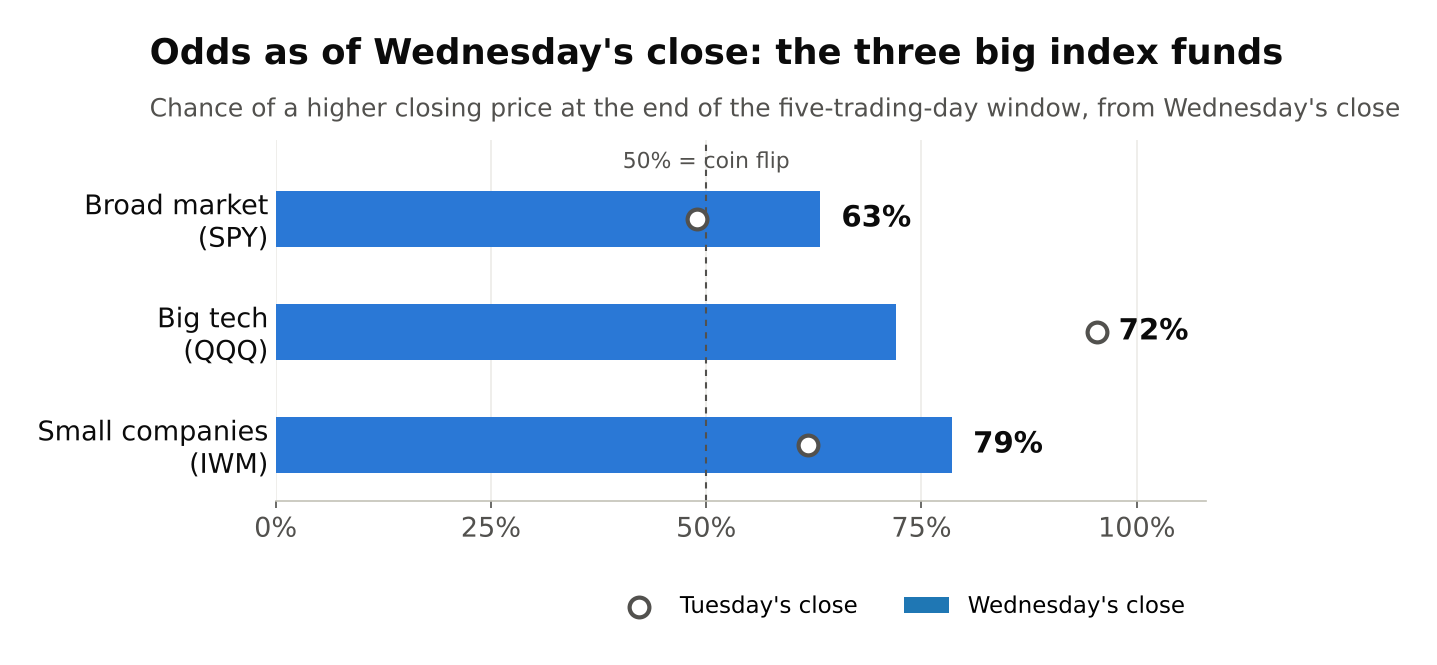
The broad market (SPY) rose from 49% to 63%, and small companies (IWM) from 62% to 79%. Big tech (QQQ) eased from 95% to 72% but still leans higher.
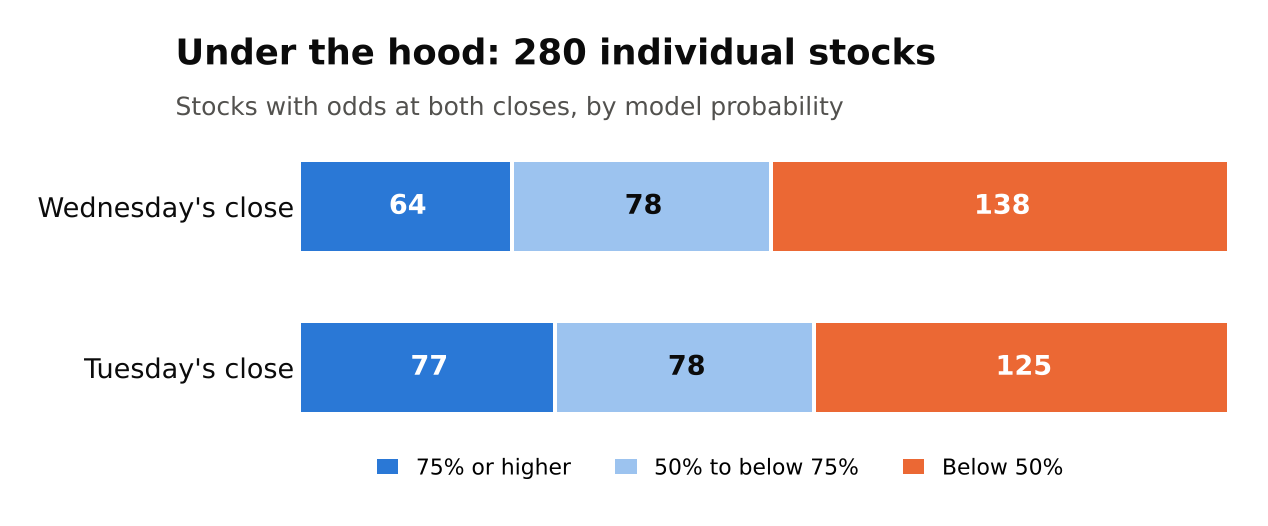
The stock count uses the 280 individual stocks we track that have odds from both Tuesday’s and Wednesday’s closes. Of those, 64 are at 75% or higher, down from 77, and the number below 50% rose from 125 to 138. The average model probability across those 280 stocks is 50.8%, down from 54.5%. Among sector funds, industrials (XLI) rose from 73% to 92% and energy (XLE) from 52% to 67%. Communication services (XLC) fell from 59% to 8%, and consumer discretionary (XLY) from 53% to 14%.
How to read this: a fund’s odds and the stock count measure different things. The fund odds forecast the basket’s closing price; the stock counts show the distribution of forecasts across individual companies. Today, several major fund forecasts improved while the individual-stock outlook weakened. That supports being more selective than the index headlines suggest.
News research cutoff: approximately 9:10 a.m. Eastern on November 5; social-discussion research through 8:40 a.m. Eastern. PTP publishes general market opinion and probability research for education. Forecasts are estimates, not guarantees.
Probability Trader Pro publishes probability research for education only. It is not investment advice or a recommendation to buy or sell any security. Probabilities are projections from historical data; they are not certainties. Company figures are from the companies’ own releases.
PTP Pro
Go beyond one daily selection with PTP Pro: full probability tables, over 300 stocks and ETFs, and cash-secured put and covered call levels.
$99first year
then $299/year, renews until you cancel.
30-day money-back guarantee on the $99 offer.
Holiday offer ends Dec 31, 2026.
Educational market commentary only. Not investment advice, and not a promise of results.