
The Probability Outlook
The market shook off the election scare. I’m selectively bullish.
Archived issue, 11-04-2026. Odds and methods are as of that date; see the Method page for the current Four-Gate rules.
James’s Read
Democrats won control of Congress, and stock futures reversed an overnight selloff before Wednesday’s opening bell. My read: the recovery gives us reason to lean bullish, but the election could change which stocks lead. I’d favor companies delivering results and resist chasing a stock simply because someone calls it an election winner.
The market had an opportunity to keep falling as the results arrived. Instead, buyers returned. That’s encouraging, although I want to see whether the buying lasts beyond the initial reaction.
My approach would be to look for strength that holds through a pullback, rather than rush after the first jump. What would change my mind: a recovery that unravels during regular trading, with weakness spreading across sectors. Tomorrow, we’ll revisit whether buyers followed through or merely interrupted the selling.
The election changed the conversation. Did it change the business?
The investor conversations we reviewed split into two camps. One sees the election as a major uncertainty finally cleared. The other sees a threat to the AI boom, particularly the enormous data centers that need electricity, land and permits.
The morning’s market offered evidence for both views. At approximately 9 a.m. Eastern, Dow futures were up 2.3%, S&P 500 futures 1.1%, and Nasdaq futures 0.3%. Clean-energy shares were stronger, while several data-center names were under pressure. Investors were distinguishing between industries rather than moving everything together. Source: Forbes, Reuters
Starting in January, a Democratic Congress will face a Republican president. That creates the prospect of more oversight and disagreements over policy. It does not tell us which proposed rules will become law or which construction projects will face delays. Source: AP via Spectrum News
An election result is a reason to reassess a company’s prospects. It isn’t evidence that its business deteriorated overnight.
AMD illustrates the distinction. Its quarterly revenue rose 45% to $13.4 billion, and data-center sales increased 97% from a year earlier. Management expects approximately $17 billion in revenue next quarter. That is substantial demand, even with questions about how quickly the industry can keep expanding. Source: AMD earnings release
I’d give more weight to companies turning that demand into profitable growth than to broad predictions about what the election means for every AI stock.
What our odds say. These forecasts were calculated at Tuesday’s close, before the election results, and do not incorporate the overnight news. They back the “selective” part of the call. Our models gave big tech (QQQ) a 95% chance of closing higher over the five-trading-day forecast window measured from Tuesday’s close, and the chip fund (SMH) 76%. The broad market (SPY) sat near a coin flip at 49%. That gives me a stronger bullish lean toward technology than toward the broad market, while remembering that these forecasts preceded the overnight news.
Also today
Tesla is getting a different reception. Shares were down approximately 4%–5% before the open even as broader futures rose. Political exposure featured prominently in market commentary, although the price move alone cannot establish its cause. My takeaway: a rising market can leave a well-known stock behind. I wouldn’t assume every familiar technology name participates equally in a recovery. Source: Reuters, Forbes
Clean energy is attracting fresh attention. Renewable-energy stocks rose before the open as investors reassessed the policy outlook. I’d watch whether that interest survives the first burst of enthusiasm. A stronger political narrative can lift prices quickly; improving company prospects take more evidence. Source: Reuters
One useful distinction: rotation means leadership is changing between parts of the market. It does not necessarily mean the whole market is weakening. Watch what is gaining strength alongside what is losing it.
The probabilities
After every close, our models update the odds of a higher closing price at the end of the five-trading-day forecast window than at that close. These are from Tuesday’s close, before the election results. In the chart, bars are Tuesday’s odds and dots are Monday’s.
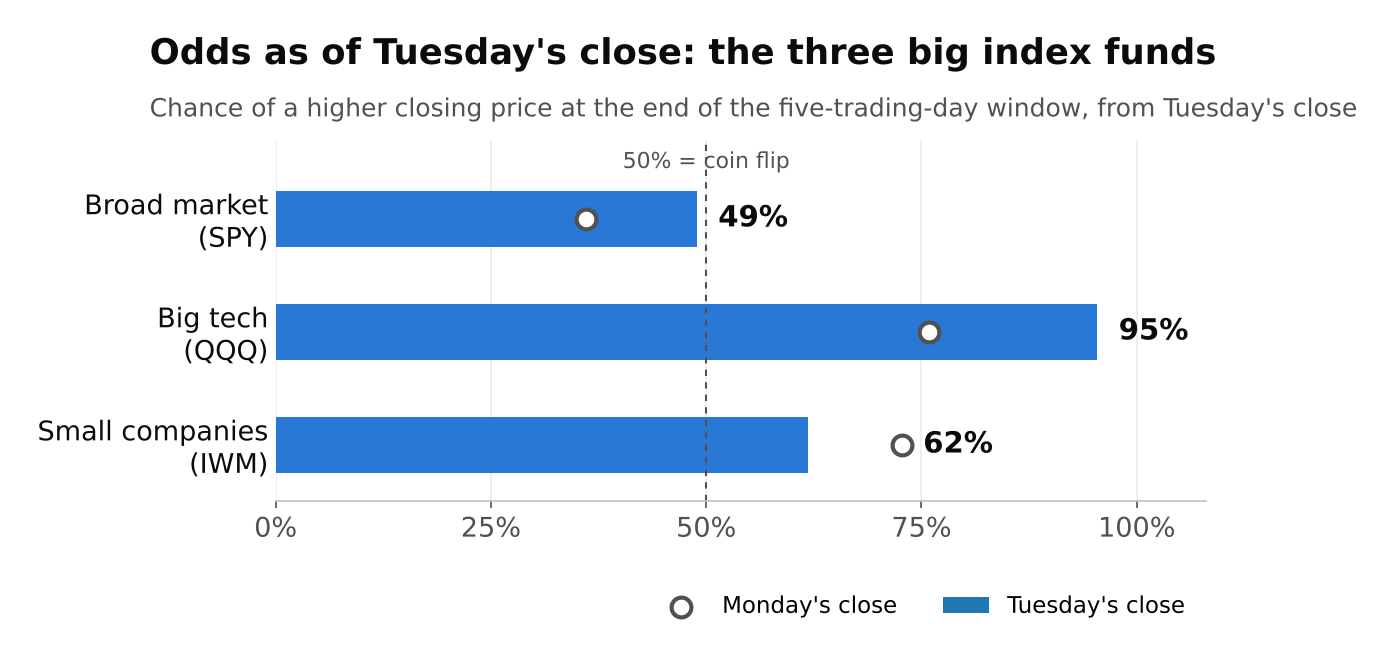
Big tech (QQQ) jumped from 76% to 95%. The broad market (SPY) rose from 36% to 49%, about a coin flip. Small companies (IWM) eased from 73% to 62%. The forecasts can differ across funds; a favorable outlook for technology does not require an equally strong outlook for the whole market.
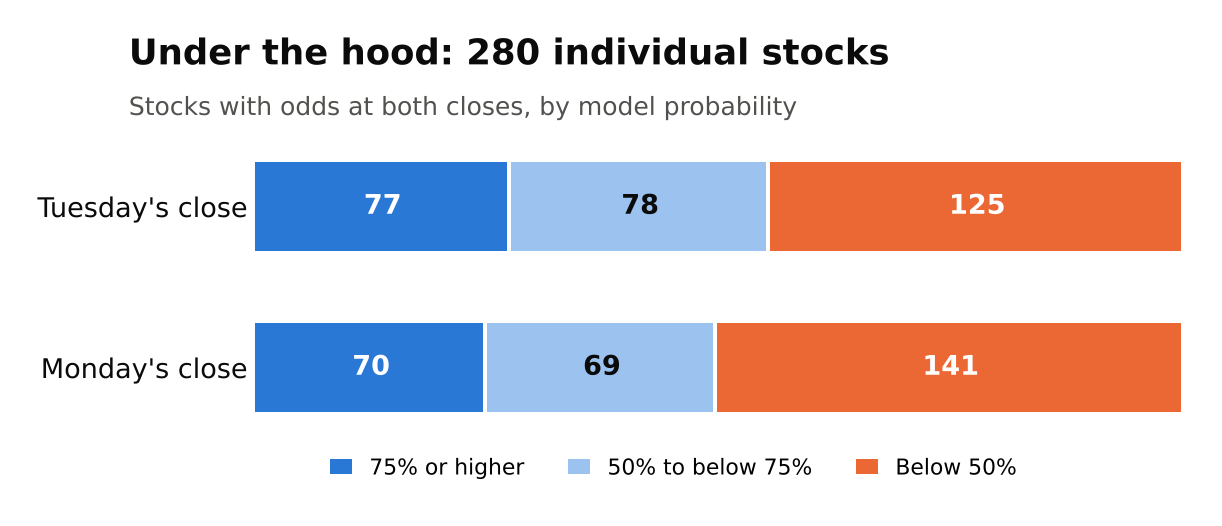
The stock count uses the 280 individual stocks we track that have odds from both Monday’s and Tuesday’s closes. Of those, 77 are at 75% or better, up from 70, and the number below 50% fell from 141 to 125. The average model probability across those 280 stocks is 54.5%, up from 51.9%. Among sector funds, financials (XLF) rose from 55% to 74% and industrials (XLI) from 53% to 73%, while consumer discretionary (XLY) fell from 70% to 53%.
How to read this: a probability tells you how likely a higher close is, not how far prices might move. A fund at 95% can still finish lower, and a fund at 49% can still rise.
Commentary reflects information available before the November 4 opening bell. PTP publishes general market opinion and probability research for education. Forecasts are estimates, not guarantees.
Probability Trader Pro publishes probability research for education only. It is not investment advice or a recommendation to buy or sell any security. Probabilities are projections from historical data; they are not certainties. Company figures are from the companies’ own releases.
PTP Pro
Go beyond one daily selection with PTP Pro: full probability tables, over 300 stocks and ETFs, and cash-secured put and covered call levels.
$99first year
then $299/year, renews until you cancel.
30-day money-back guarantee on the $99 offer.
Holiday offer ends Dec 31, 2026.
Educational market commentary only. Not investment advice, and not a promise of results.