|
Probability Trader Pro
Probability Outlook
Tuesday, November 3, 2026 · Odds as of Monday's close
It's Election Day, and the market goes into it pulled two ways. Chipmakers kept falling on Monday, while oil had one of its biggest drops in months on signs of progress with Iran. Then, late Monday, U.S. forces struck Iran's Qeshm Island. Here is what happened, what our models make of it, and how we read it all.
World and local news
On Monday the S&P 500 slipped about half a percent and the Nasdaq fell about 1%, while the Dow edged higher. Chip stocks led the decline again, extending last week's selling over whether the huge sums going into AI are paying off yet.
The day's biggest deal came from that same corner of the market. Marvell agreed to buy Lumentum, which makes the lasers and optical parts that move data between AI chips, in an all-stock deal valuing Lumentum at about $115 billion including debt. Lumentum holders get 4.5 Marvell shares for each share they own and will hold about a third of the combined company. Marvell's stock fell sharply last week when talks were first reported, a sign investors are uneasy about the price. Source: Marvell and Lumentum SEC filing
Oil fell roughly 7% on Monday after Vice President Vance said the U.S. had "certainly made some progress" in talks with Iran. That night, Qatari mediators traveled to Tehran to discuss a draft deal, and U.S. forces carried out what officials called limited, defensive strikes on Qeshm Island in the Strait of Hormuz, aimed at Iranian surface-to-air missiles used against U.S. assets. U.S. officials said this was not a return to war. A senior Iranian official told Reuters the two sides remain far from a deal and that Tehran would respond. Lower oil helps airlines, cruise lines and the inflation outlook; a breakdown in talks would reverse that quickly. Source: CNBC
Apple reported after Monday's close, John Ternus's first report as CEO, and memory-chip costs were the story: its gross-margin outlook for this quarter came in below what analysts expected, and the shares slipped after hours. Today Americans vote in the midterm elections, so the market's first full reaction comes Wednesday. AMD reports after today's close, another test of the AI-spending question.
The market conversation
In the posts our research agents sampled on X since Monday's close, three conversations stood out. The first is oil: many traders welcomed the drop as relief on inflation, while skeptics noted that no deal has been signed and earlier breakthroughs fell apart. The second is AI spending. Bears focus on how much of it is being paid for with borrowed money and how long the payoff will take; bulls argue that demand for AI chips is held back by power and equipment, not a lack of buyers, and some call chip stocks oversold. The third is the election, with posts citing the market's history of doing well after midterms, tempered by everything else going on. The sampled discussion leaned defensive. This is a sample, not a poll of the whole platform, and social media shows what traders are watching; it isn't evidence of what will happen.
The probabilities
After every close, our models update the odds that each fund will be higher about a week from now. A 50% reading is a coin flip. In the chart, the bars are the odds from Monday's close and the dots are where each fund stood after Friday's close.
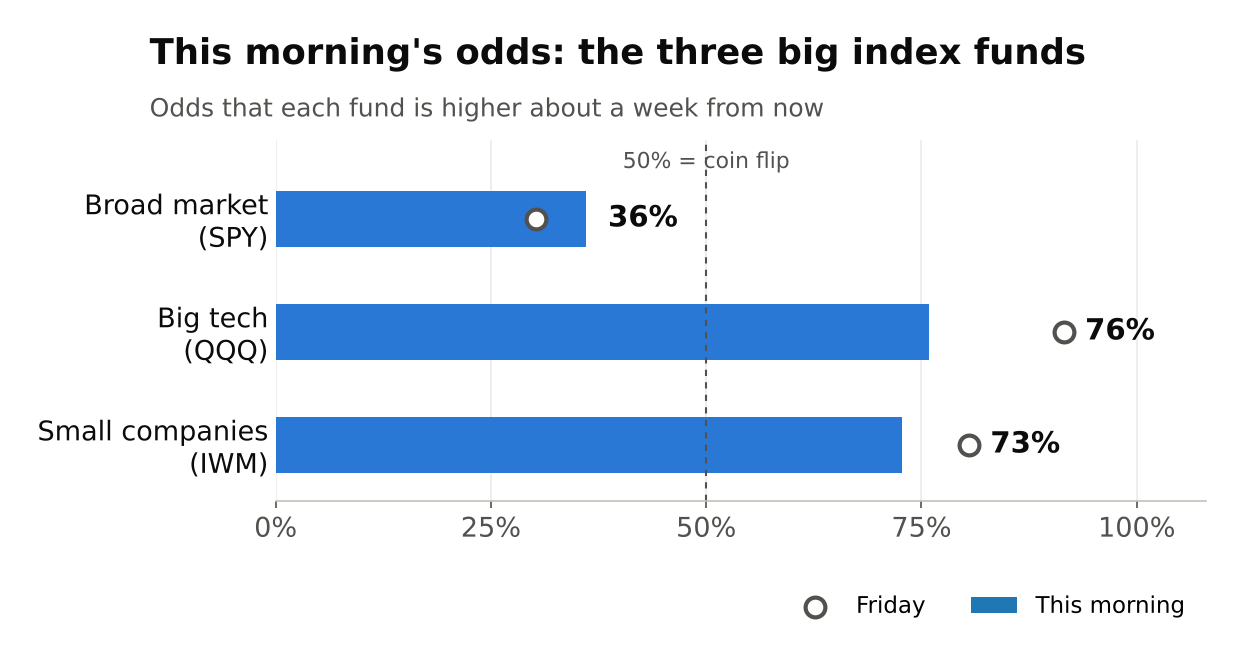
Big tech (QQQ) slipped from 92% to 76% but still leans clearly higher. Small companies (IWM) eased from 81% to 73%. The broad market (SPY) edged up from 30% to 36%, still leaning lower. Each fund has its own model, built from its own price history, so they don't have to agree.
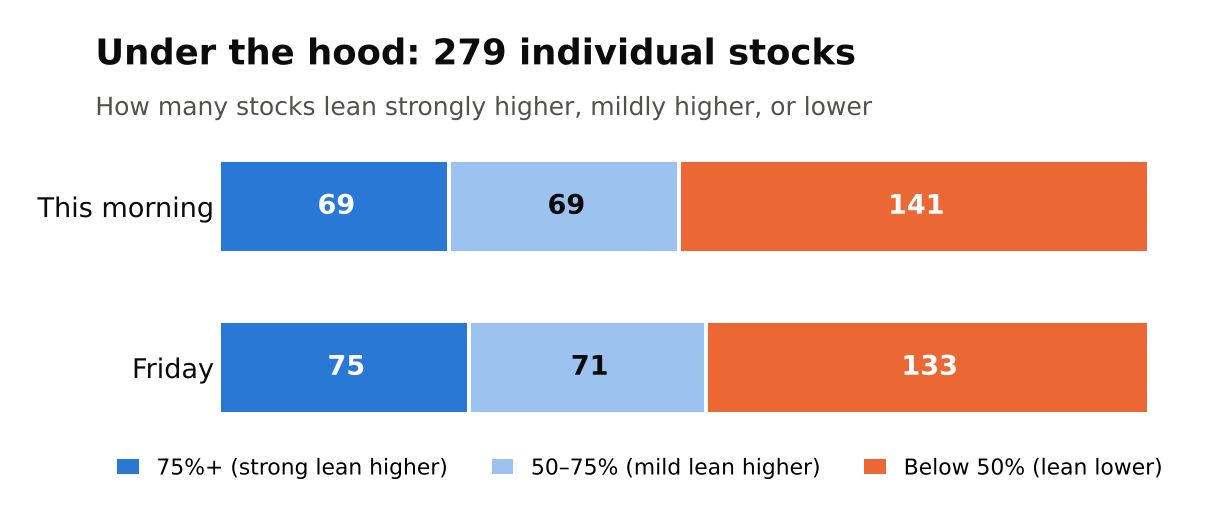
Underneath, the picture softened a little. Of the 279 stocks with odds on both days, 69 are at 75% or better, down from 75, and the number leaning lower rose from 133 to 141. The average stock sits at 52%. The sector funds split sharply. Energy (XLE) went from 16% to 52%, about a coin flip, and industrials (XLI) from 21% to 53%. The chip fund (SMH) rose from 70% to 81% even as chip stocks fell. Communications (XLC) dropped from 75% to 46% and consumer discretionary (XLY) from 96% to 70%.
The PTP Verdict
What the evidence supports. After Monday's selling, our models still give big tech and the chip fund clearly better-than-even odds of being higher a week from now, at 76% and 81%. Energy moved from strongly lower to about a coin flip, and the broad market's odds improved slightly. These odds describe where prices may close in a week, not why or how they get there.
The strongest argument against it. The news is less encouraging. In our review of Monday's headlines, several chipmakers, including Marvell, came out on the negative side, and the AI-payoff question is real. AMD reports tonight, fewer individual stocks lean higher than on Friday, and the Qeshm strikes show how fast the Iran story can turn. Our models can't see election results.
What would change our view. A disappointing AMD report, an election result that rattles markets, or Iran's response sending oil sharply higher would all weaken the case for chips and big tech this week, whatever the odds say. If the talks hold and AMD reassures, the case gets stronger.
This is our reading of the evidence for education, not a recommendation to buy or sell anything.
| How this newsletter is made. Our machine-learning models compute the odds from each stock's price history. Several AI research agents scan the news and social media, working independently so one can catch what another misses. We check the news items we publish against original sources, such as company filings and major news outlets; social-media posts are reported as conversation, not fact. James Krider, MD, reviews each issue before it goes out. AI helps us read the market faster. It doesn't predict it. |
Probability Trader Pro publishes probability research for education only. It is not investment advice or a recommendation to buy or sell any security. Probabilities are projections from historical data; they are not certainties. Levels are based on historical frequencies; they are not predictions or guarantees. Options involve risk and are not suitable for all investors. Company figures are from the companies' own releases.
|
